I Finally Landed My Dream Job.
It Turned Out to Be My Nightmare.
Compavra is a career compatibility engine. It reads where you thrive and how you prefer to work, then shows you the paths that fit you. Find yours.
A clearer direction for your future.
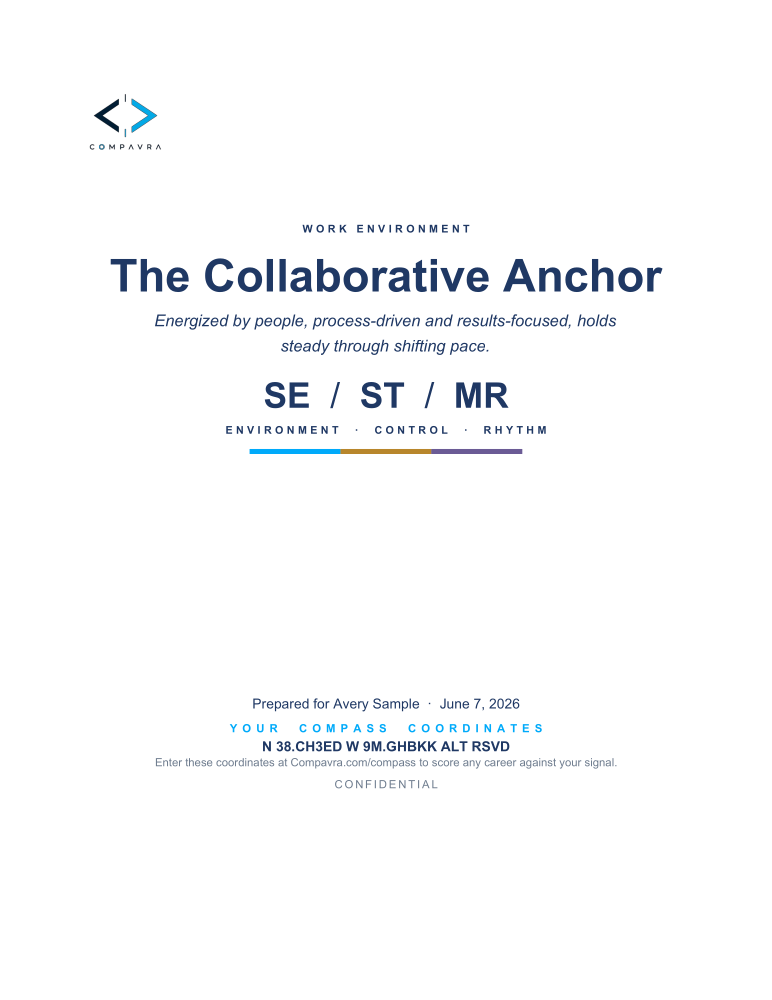

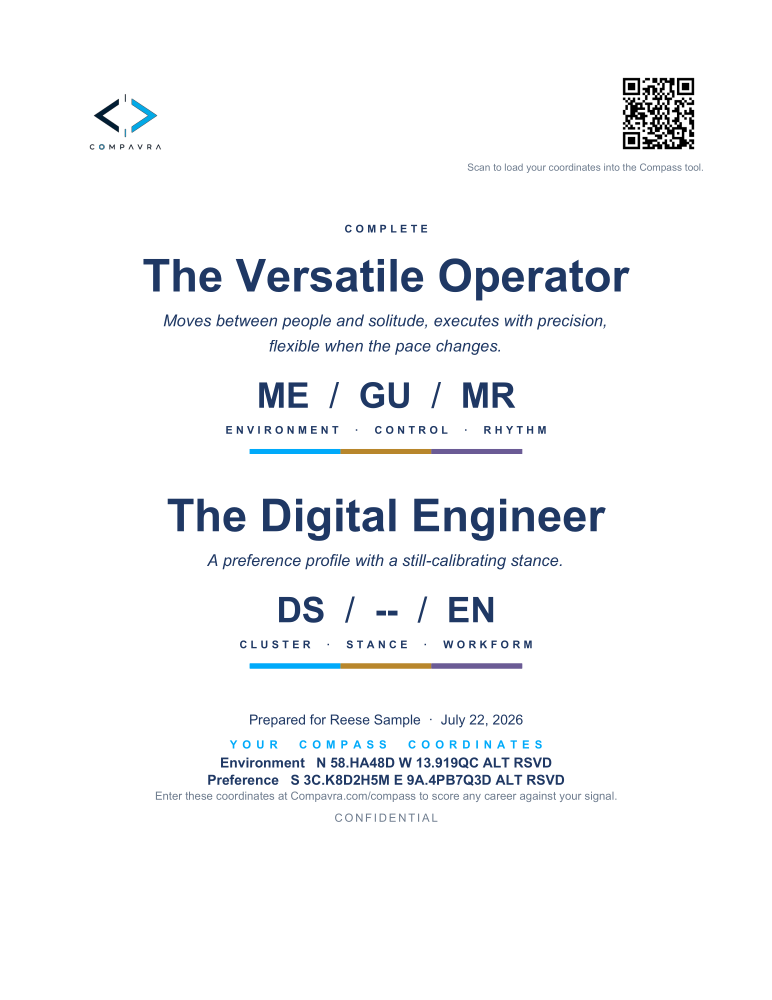
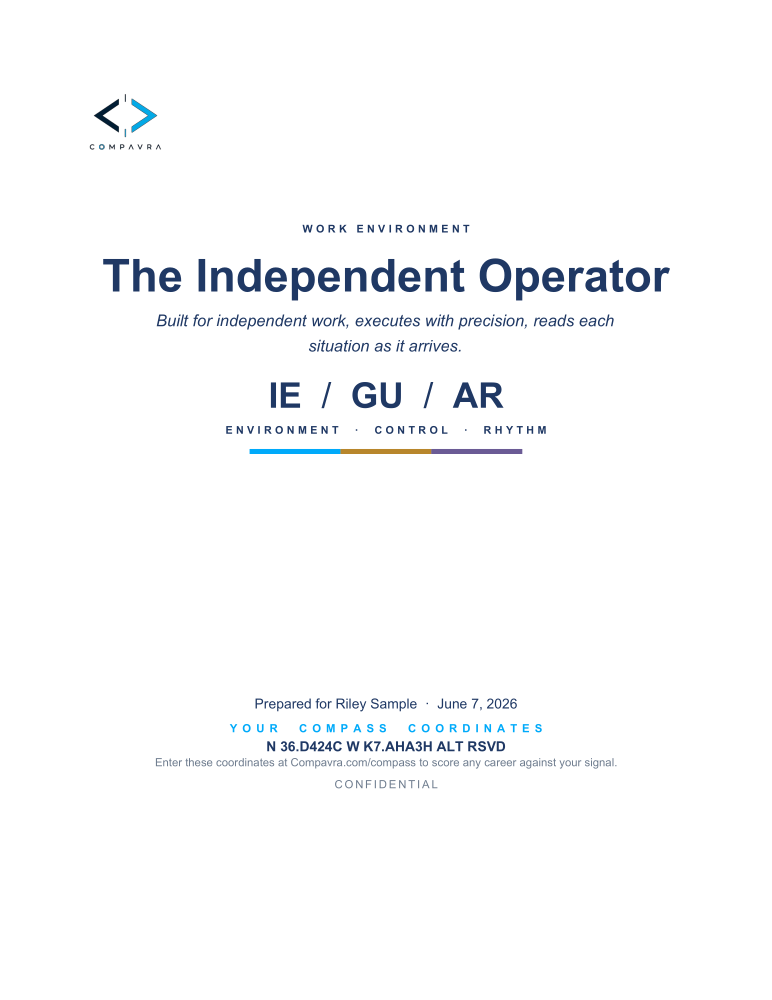
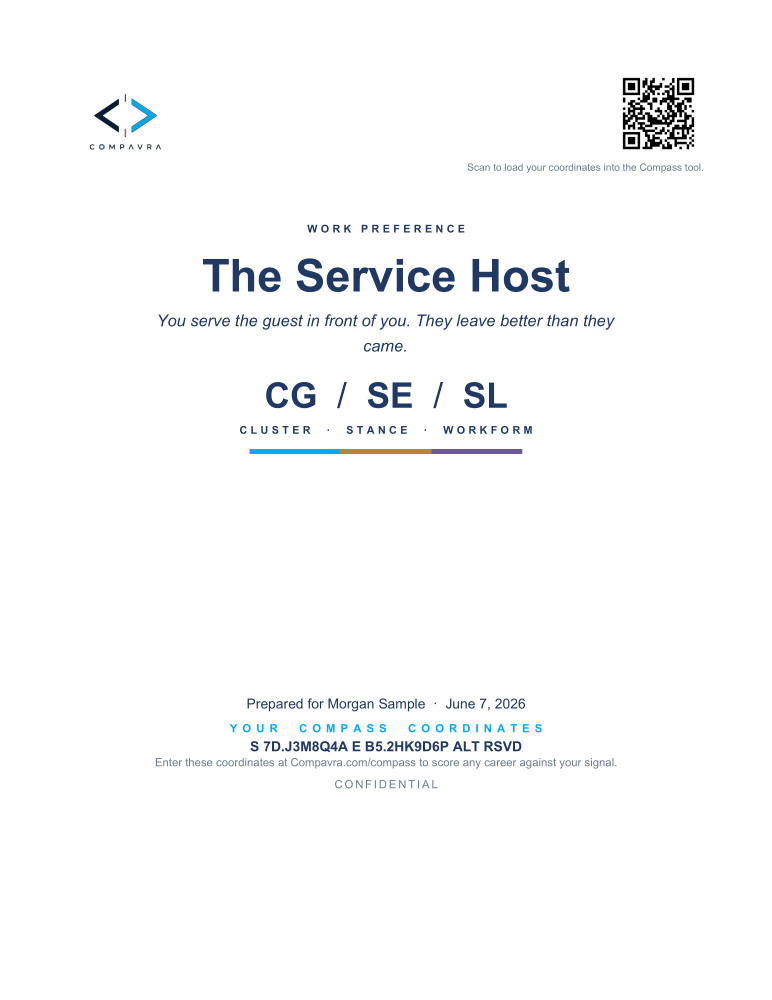
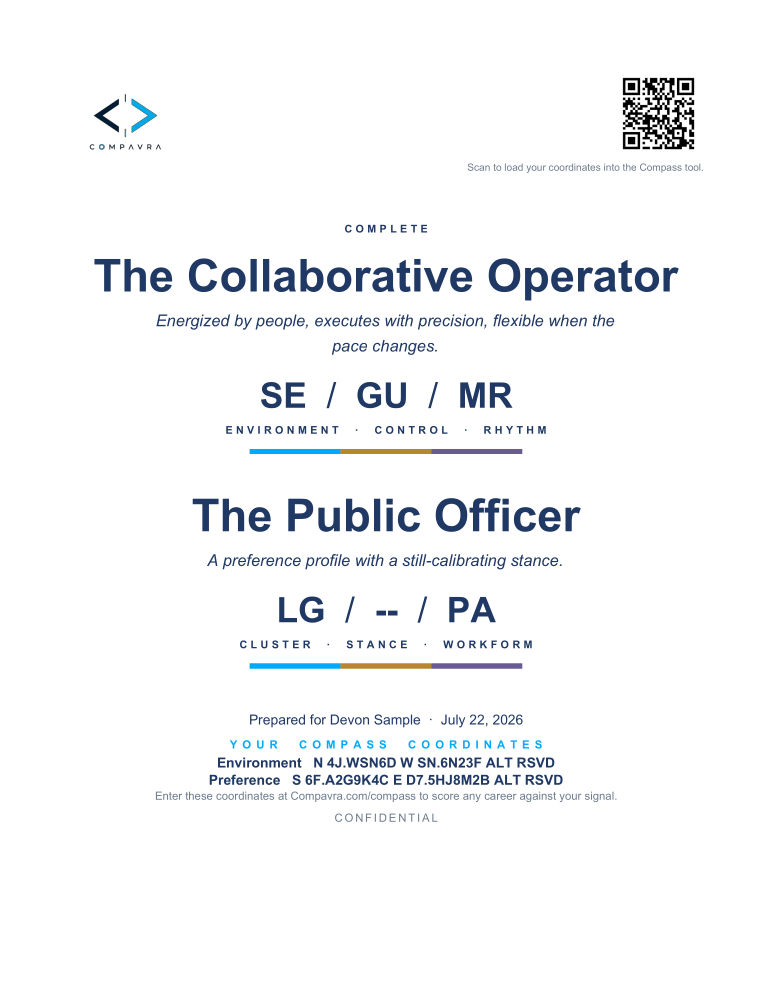
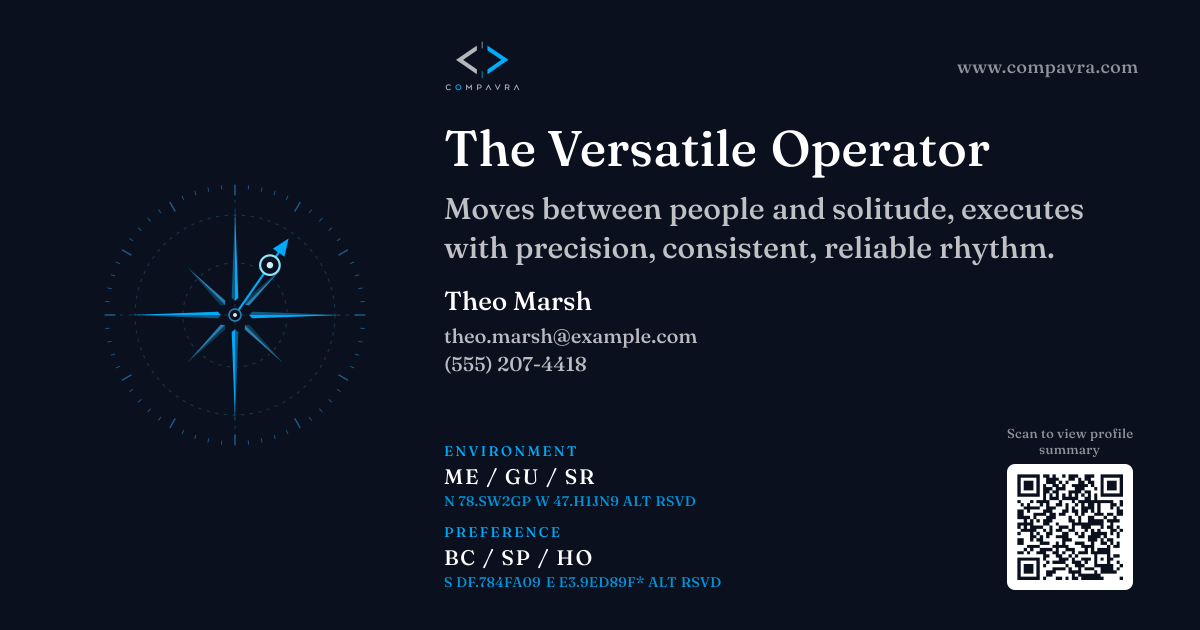
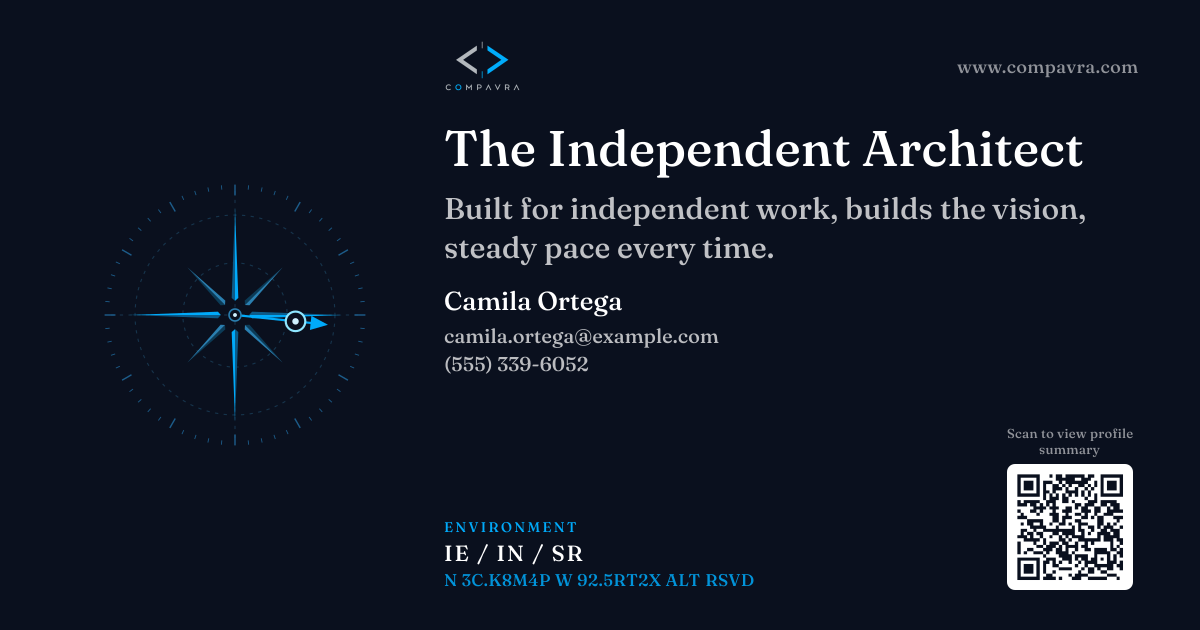
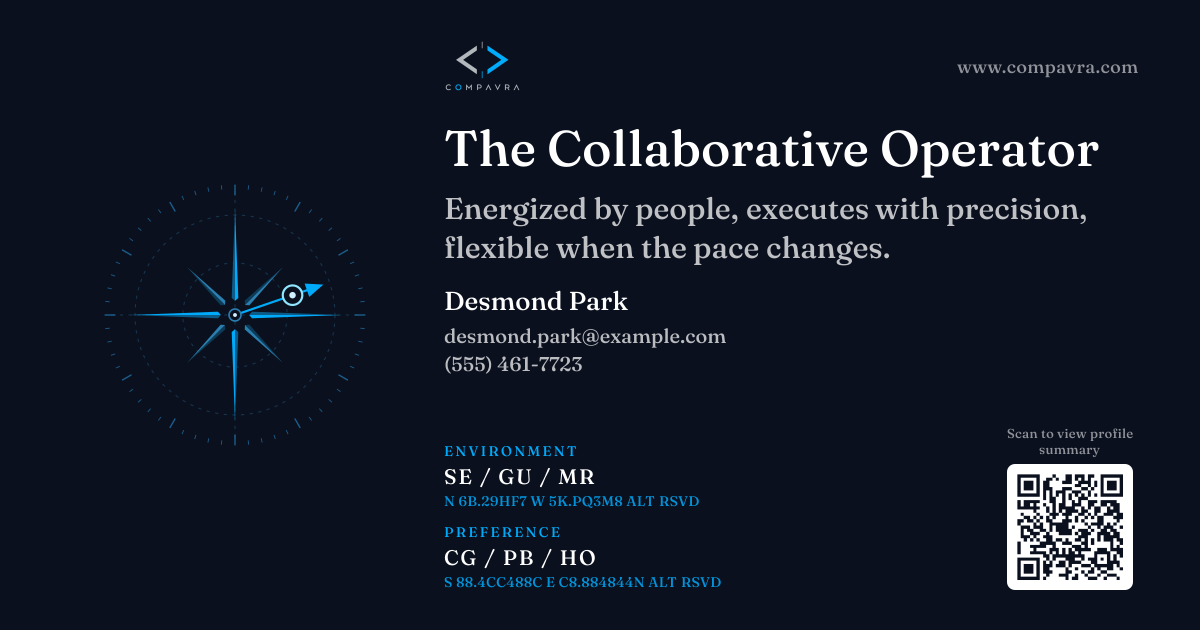

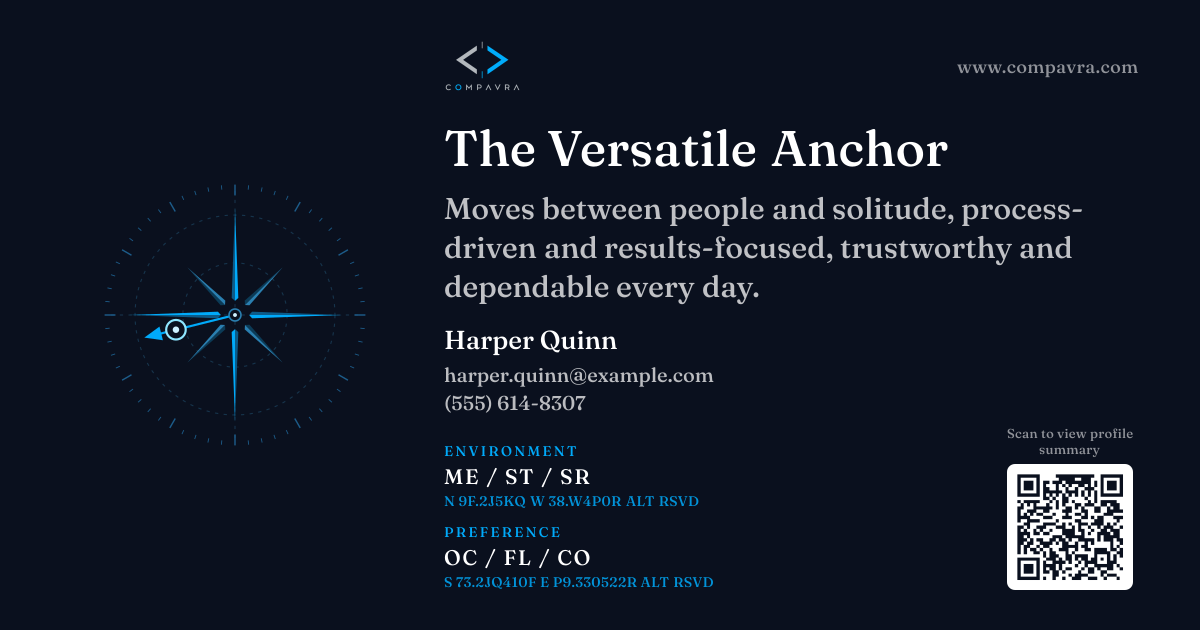
Two coordinates, one fit
- N / W
- Environment - where you thrive
- S / E
- Preference - how you prefer to work
A card you keep and share.
Beyond your report and your coordinates, you keep a digital career card. Share it with a career counselor, pull it up at a networking event or job fair, or send it to a friend. It is your signal in your pocket, ready whenever you need it.
A lifelong tool. Take it once, carry the coordinates for good.
Your Compass
Most career assessment websites give you a list of jobs and forget you. The Compass keeps working for you, for as long as you need it.
- 1Your Compavra report gives you your coordinates.
- 2Pick any career, then answer a few quick questions about it.
- 3It combines your assessment coordinates with your answers about the career and tells you whether it fits you, and why.
Your report hands you your coordinates. You enter them in the tool, and it scores any career you name against your Signal.
Compavra report
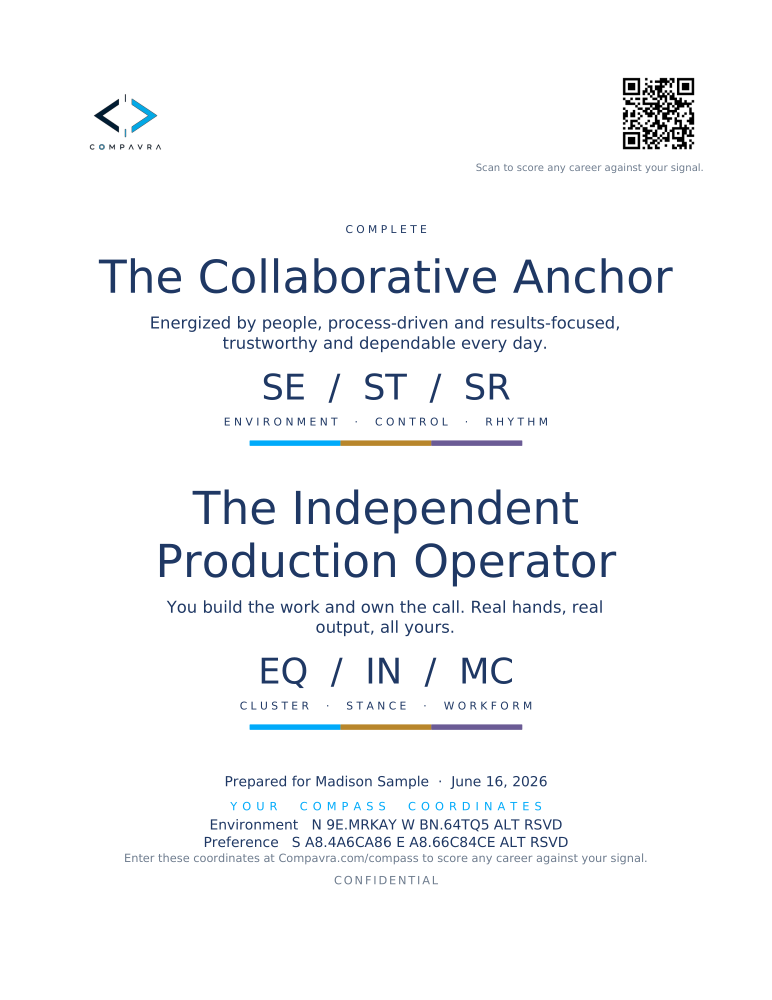
Your Compass Coordinates
N 5A.GT36S W 34.D51J1 ALT RSVD
Enter these coordinates at Compavra.com/compass to score any career against your signal.
The Compavra Compass
Evaluate any career against your Signal.
Enter your compass coordinates to begin.
Don't just choose a career. Choose a future.
The world of work is changing fast. That's why every career on your Complete map carries an Automation Resilience score, showing how likely the work is to remain human-driven as AI capabilities expand. Because the best career isn't only one that fits you. It's one that's still standing when you get there.
The score runs AR-1 to AR-5: how much of the work today's AI can already do, and how much it cannot. AR-5 is hands-on, in-person, accountable work that holds; AR-1 is routine screen work squarely in reach. You are not only choosing work that fits you, you are choosing work that lasts, and it reads on every match in your Complete.
Here is how two careers score, from resilient to exposed:
Hands-on vehicle repair work with high physical demand, high diagnostic precision, and active bay-paced execution.
Pay
$38,900 to $70,400
Training and Education
Postsecondary nondegree award
Structured financial reporting and compliance work with high precision, high stability, and low-to-moderate switching demand.
Pay
$67,000 to $109,800
Training and Education
Bachelor's degree
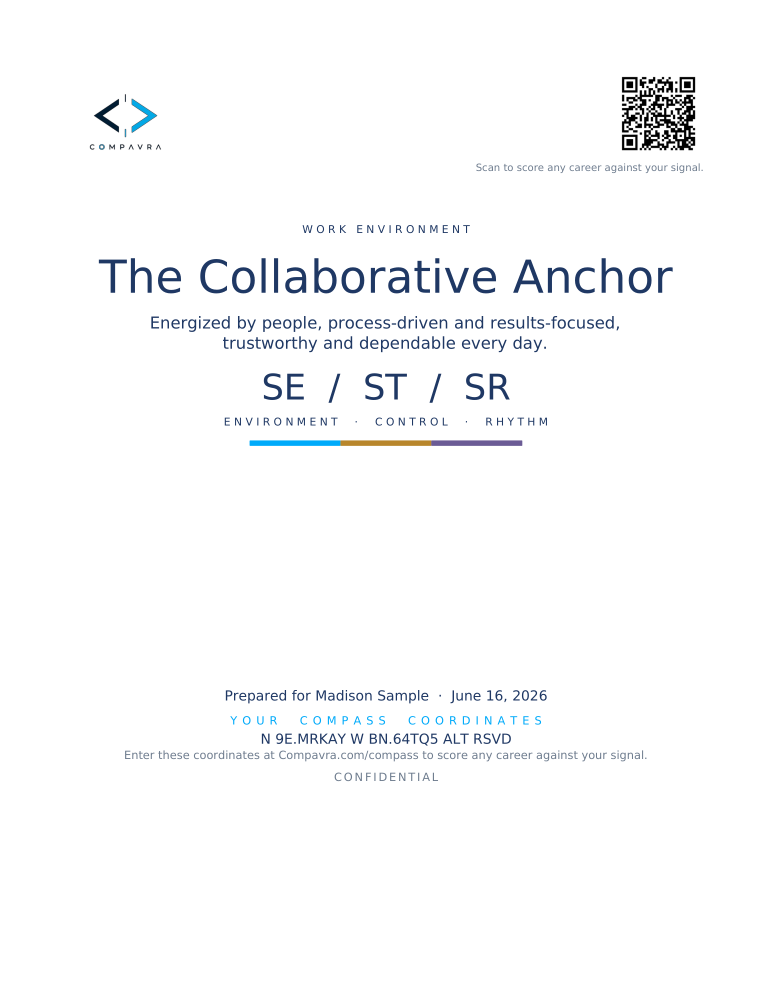
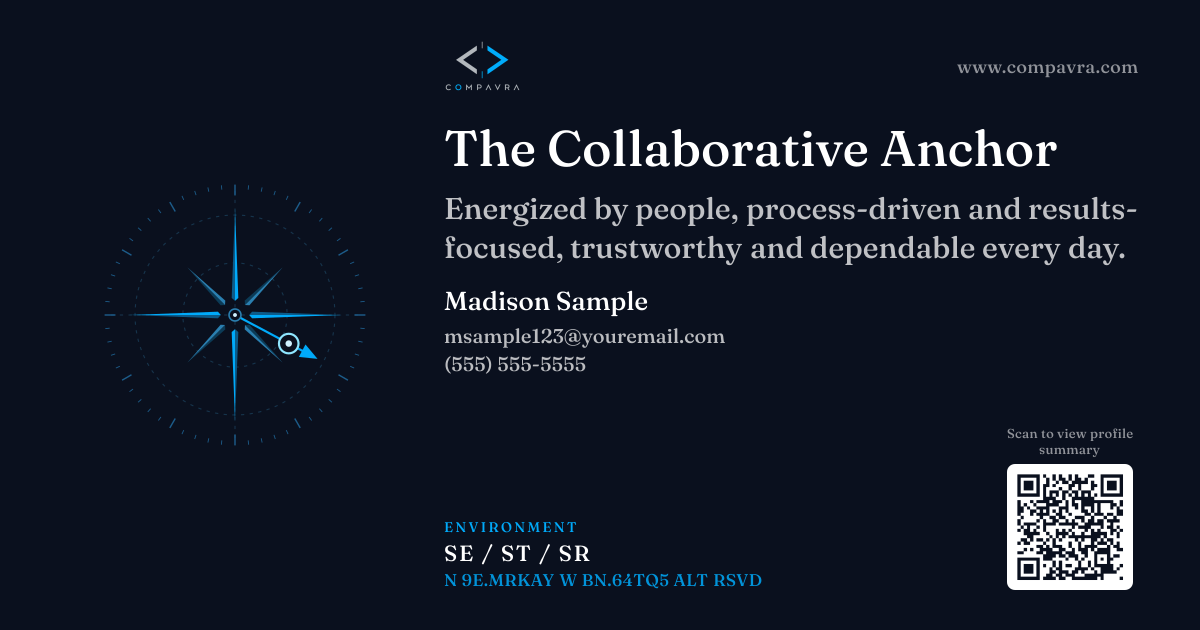
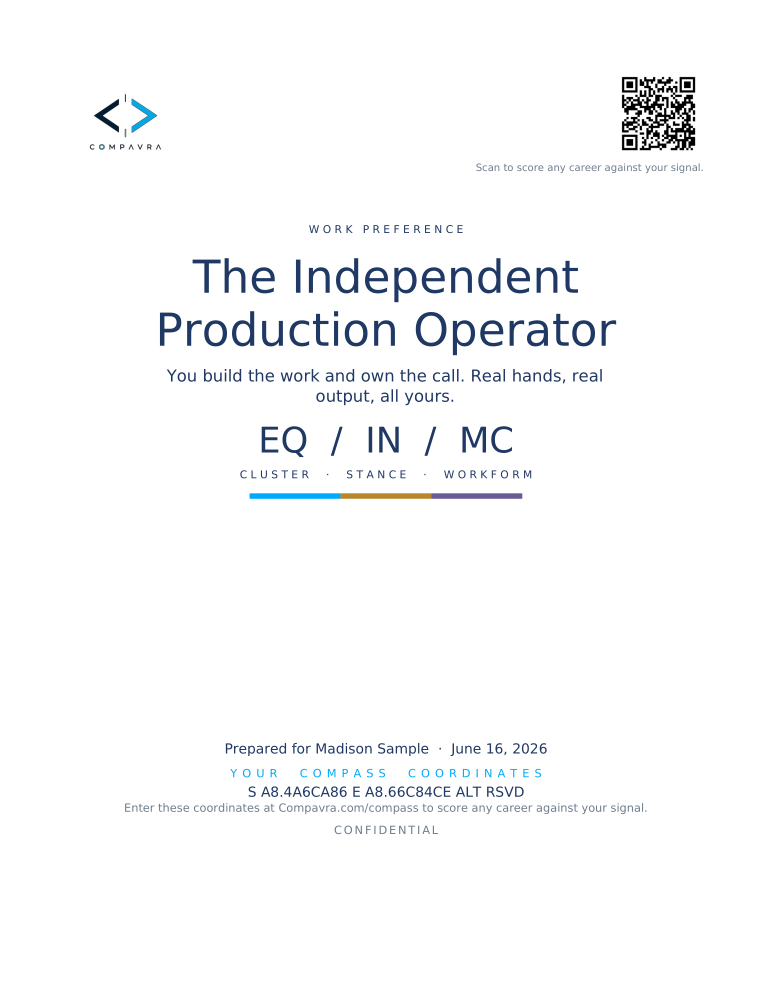
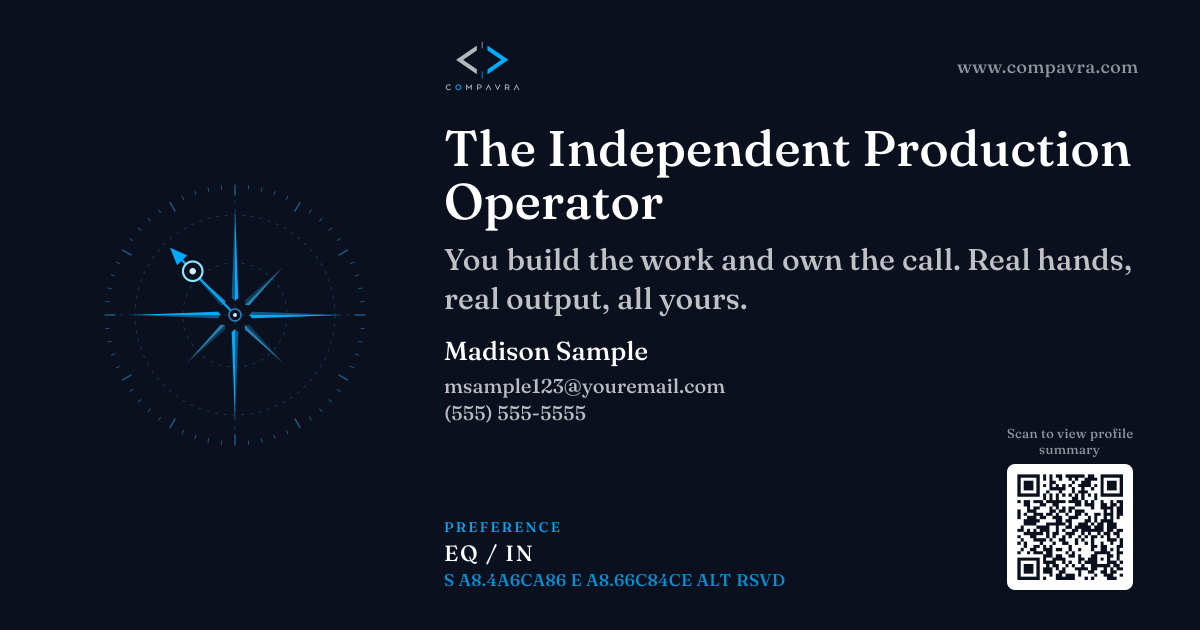
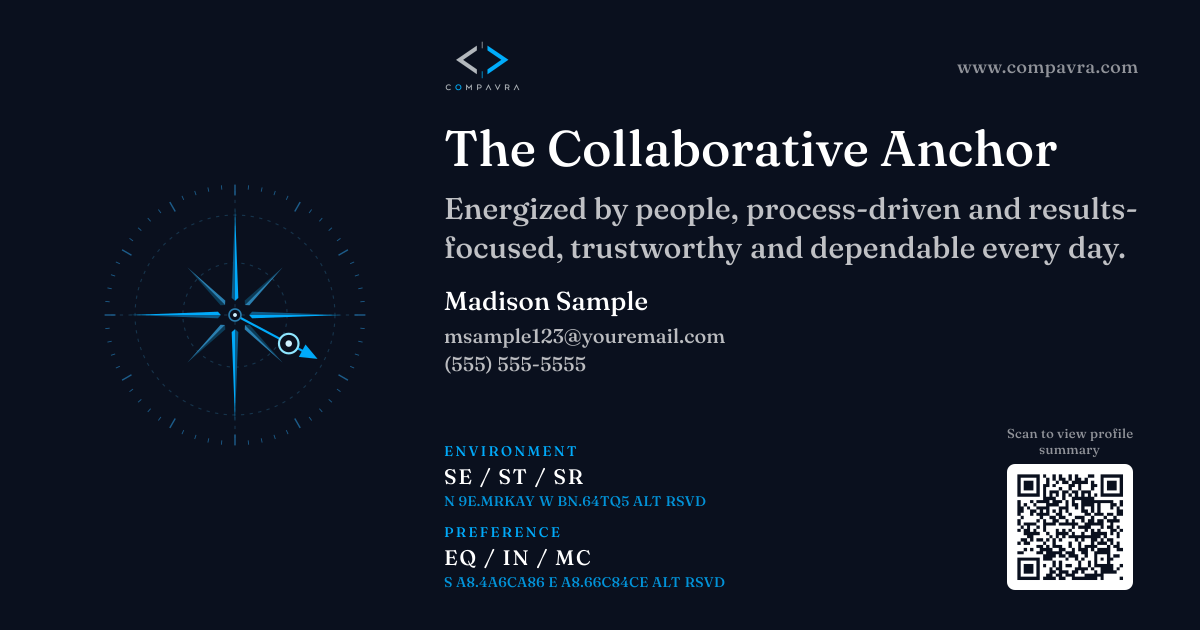
Two bearings. One fix.
Your answers resolve to two readings that cross on the map, and where they meet is your fix, the kind of work and the kind of place you are built to last in, in language you will recognize as yours. You keep it, and you navigate by it: hold any opportunity against your coordinates and see, before you leap, whether it fits.
Fifteen minutes to check your course. Honest answers. A signal you navigate by for years.
- Step 01
Answer honestly
Not as the job you have, not as the person you wish you were. As you actually are on a normal Tuesday.
- Step 02
Read your coordinates
Your position across the three waypoints, and what it means in plain words.
- Step 03
Navigate by it
A report you keep and the Compavra Compass, the tool you hold every future opportunity against.
Reliability
We built Compavra to give people a reading of their work environment that holds up, and we tested whether it does. In an internal study, 86 people took the environment assessment twice, about three weeks apart. Across all 16 measured attributes, their results reproduced with an average reliability of ICC = 0.73, above the 0.70 mark commonly used to indicate good reliability. Every attribute came in at 0.60 or better, and most cleared 0.70. For a self-report instrument, that's a strong result, and one we're proud of.
These are internal findings from a single study. They describe reliability, how consistently the assessment reproduces results on repeat measurement, not validity, which is a separate question we're still studying. As the study grows, we'll keep these numbers honest and up to date.
How we measured this
We measured reliability by test-retest: 86 participants completed the environment assessment twice, roughly three weeks apart. Consistency was scored with a two-way mixed-effects intraclass correlation (ICC, absolute agreement, single measures) on each attribute's continuous score. Across the 16 attributes the mean ICC was 0.73 (range 0.62 to 0.82); 10 of 16 met or exceeded 0.70 and all 16 met or exceeded 0.60. As a single internal study, results are provisional and confidence intervals are wide at this sample size.
Environment reliability averages ICC 0.73 across 16 attributes (n = 86), above the 0.70 good-reliability mark.
Who it's for.
- People choosing a next move and tired of guessing.
- Career changers who want their bearings before they leap.
- Coaches who want a structured place to start.
- The signal is yours to carry anywhere.
Questions, answered.
Is this a personality test?
- No. A personality test sorts you into a type. Compavra does not type you. It reads which work pulls you and which environments let you sustain it, so your result points to where you will function well, not what you are like.
What do I actually get?
- A signal you keep, a written read in plain language, the roles that fit your coordinates and the ones that quietly won't, and the Compavra Compass for testing what comes next.
How long does it take?
- About fifteen minutes per instrument, no open writing, an instant report.
Is it for career change, hiring, or coaching?
- All three.
What does it cost?
- Work Environment $39, Work Preference $39, Complete $59 (both, a $19 saving).
What is Automation Resilience?
- A score from AR-1 to AR-5 on every career in your Complete report: how much of the work is the kind today's AI can do, and how much it cannot. Hands-on, in-person, and accountable work scores high; routine screen work scores low. It is exclusive to the Complete, so you can weigh how well a fit will hold, not just whether it fits today.
Is my data private?
- Yes. We hold the minimum needed to deliver your report, name and email, and remove the assessment profile after delivery.
Which careers are safest from AI and automation?
- The work hardest to automate is built on physical skill, in-person presence, real-time judgment, and accountability; routine screen and records work is the most exposed. Compavra scores every career on a five-level Automation Resilience scale, AR-1 to AR-5, so you can see where a path sits before you commit instead of guessing.
How do I find a career with the work-life balance I want?
- Work-life balance is mostly about environment: predictable hours, autonomy, how much you work around people, and how much pressure the role carries. Most assessments read your personality but not the place. Compavra reads both, so your results surface roles whose working conditions fit how you actually want to work.
I don't know what career I want. Where do I start?
- Start by reading two things at once: which work pulls you, and which environments sustain you. Compavra turns that into a fifteen-minute assessment with a plain-language read and a signal you keep, so instead of a list of job titles you get a direction you can navigate by.
Is it worth changing careers at 40 or 50?
- Yes, and the most useful first step is getting your bearings before you leap. A later career change works best when you choose by fit and durability rather than guesswork, so Compavra gives changers a structured read of which environments will sustain them and which roles hold up over the next decade.
How is Compavra different from a career aptitude test or personality test?
- An aptitude or personality test reads you; none of them read the place you will work. Compavra measures which work pulls you and which environments sustain it, then shows fitting roles, quietly unfitting ones, and an Automation Resilience read, which a standard career test does not give you.
Your signal has been there the whole time. You just never had the map.
Most people navigate a whole career blind, reading half their coordinates or none. Fifteen minutes here is the cheapest course correction you will ever make.
About the Founder
I spent most of my life learning the world of work the hard way, one surprise at a time.
I joined the Navy at 20 because I had no idea what else to do. Twenty years later I retired as a Chief Petty Officer, having spent my career as an Aviation Support Equipment (AS) technician, the person who keeps everything running: hydraulics, power generation, firefighting gear, all the unglamorous machinery behind aircraft maintenance and service. After that I contracted overseas in Iraq and Afghanistan, then took a job as a mobile service technician that, almost by accident, turned into a decade in sales and service. I won the company's top awards for both sales and service, more than once, not bad for a guy who'd never sold a thing in his life.
That was the pattern everywhere I went. I kept meeting people, electricians, plumbers, tradesmen, managers, building real lives and real money in careers I'd simply never been told about. A neighbor running his own electrical business. A guy at Walmart out-earning people I'd assumed made far less. And I kept thinking: I wish someone had told me this at 18.
Nobody ever mapped out the world of work for me. So I decided to build the map.
Compavra started as a YouTube channel, me interviewing people about what they actually do for a living. Then it became something bigger: an assessment built to help you understand your own strengths, and where they fit, before you spend years finding out the hard way.
Leading sailors taught me that everyone is built differently, and the real work is drawing out the best in each person. That's what Compavra is for.